
The Japan Management Association (JMA) organizes more than 30 B2B exhibitions annually across a wide range of industries, from food and beverage to machinery and building facilities. ShapeWin Co., Ltd. implemented a content marketing strategy to highlight the unique selling points (USP) and increase brand awareness of JMA’s exhibitions. Through strategic SEO, we successfully drove significant traffic growth and achieved top-tier search engine rankings for high-volume head keywords.
Shifting Brand Perception: From a Stationery Brand to a Leading Exhibition Organizer
For many in Japan, the name “Japan Management Association” (JMA) is synonymous with the business stationery brand “NOLTY” (formerly known as Nouritsu Techo). In fact, when telling others about our work with JMA, we were often asked, “Are you handling PR for their planners?” However, as a general incorporated association, JMA provides a broad suite of services, including management training, education, and corporate certifications, primarily for the manufacturing sector.
In the exhibition industry, RX Japan (formerly Reed Exhibitions Japan) is widely recognized as the largest player, organizing events across sectors from manufacturing to IT and services. Nevertheless, the exhibition business is a core pillar for JMA as well, with over 30 exhibitions held annually at major venues like Tokyo Big Sight and Makuhari Messe. Enhancing JMA’s recognition as a premier exhibition organizer was critical for attracting new exhibitors and encouraging existing ones to participate in multiple events.
The foundation for this project was built on ShapeWin’s prior experience providing PR support for JMA, where we served as the press office and managed media relations for individual exhibitions. JMA’s flagship event is FOODEX JAPAN, the largest of its kind. For four years starting in 2016, we served as the comprehensive PR contact for the entire exhibition, securing extensive media coverage through strategic PR initiatives. Our track record in raising the profile of various events —such as “HOSPEX” (medical equipment), the “Heat Countermeasure Expo,” and the “Hoteres Japan” (Hotel & Restaurant Show) —led to our appointment to lead the digital marketing efforts for JMA’s Industrial Promotion Center (Exhibition Department).
Implementing Digital PR through Owned Media Operations
Historically, JMA’s promotional activities as an exhibition organizer centered on regular advertising in economic and industrial media, such as The Nikkei (Nihon Keizai Shimbun). While this approach successfully broad readership reach and the credibility associated with prestigious publications, it lacked sufficient reach to the target decision-makers who attend or exhibit at these events. Consequently, there was a clear need for digital PR initiatives leveraging SEO and SEM.
ShapeWin was commissioned to handle digital initiatives, including content marketing and SEO, for the portal site “Exhibition.com”(now closed), which was planned by JMA’s PR team. Following the site’s launch, we took over operations from the production agency and began our strategic implementation.
The Importance of High-Volume SEO for Brand Awareness
In SEO and content marketing, the focus is often placed on conversions —such as inquiries or document requests. However, SEO also plays an indispensable role in building brand awareness. In particular, achieving high rankings for big head keywords contributes significantly to enhancing brand recognition.
Search engine queries using broad keywords are typically made by users seeking general information about a specific category, product, or service. For instance, a user searching for the term “exhibition” (展示会) is often browsing with a vague interest in discovering what kind of events exist for visiting or exhibiting purposes. By ensuring the JMA brand appears at the top of these search results, we improve brand visibility and increase the likelihood that the customer will select JMA when they move toward more specific, detailed searches.
That said, ranking for high-volume keywords is an immense challenge. Our strategy went beyond technical SEO —such as HTML coding optimization and site speed improvements —to focus on improving the site’s authority through comprehensive content expansion.
Strategies for Scaling Content Production
When ShapeWin took over the site’s operations, a few exhibition reports were already live, but the volume of content was overwhelmingly insufficient. However, producing a single exhibition report requires significant effort, from defining a unique editorial angle to coordinating interviews among hundreds of exhibiting companies.
To overcome this, we conducted multiple interviews with exhibitors at each event, compiling “customer success stories” that detailed their exhibits and the results they achieved. Across 13 major exhibitions, we interviewed 30 to 60 companies per event, turning their reasons for exhibiting, product details, and outcomes into high-quality articles. This approach allowed us to publish a large volume of highly original content. Furthermore, these articles served as a promotional tool for the exhibitors’ own products, significantly increasing their satisfaction with the association.
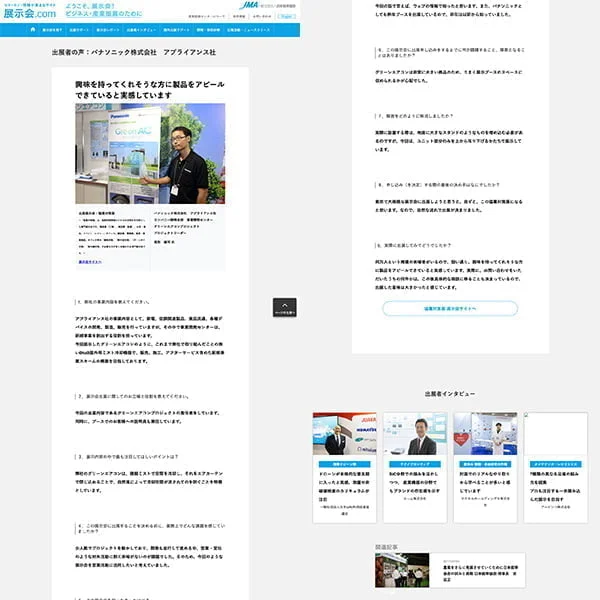
Exhibitor Interview Articles
Link Building
In fact, our content creation strategy centered on exhibitor interviews served a dual purpose by facilitating natural link building. By notifying the exhibitors’ marketing and PR departments of their featured articles, many chose to share the news on their official corporate websites and social media channels. This allowed us to earn high-quality backlinks from their domains. Since many of the exhibiting companies are well-established industry leaders or large corporations, we were able to secure numerous backlinks with high Domain Authority (DA).
Link building—the process of acquiring links from external websites—is a critical component of SEO, as high-quality backlinks are essential for improving search engine rankings. However, it is not just about the quantity of links; the relevance and context of the referring site are paramount.
Achieving 2nd Place for the High-Volume Keyword “Exhibition”
In addition to our content strategy, we performed a comprehensive overhaul of key on-page elements, including titles, meta descriptions, and H1 tags across the entire site. After two years of consistent execution, the site successfully ranked 2nd in search results for the high-volume keyword “Exhibition” (展示会).
Securing the second spot as a relatively young domain—while competing against major industry players like the Nikkan Kogyo Shimbun and KADOKAWA’s Walkerplus—is a remarkable achievement. At the time, the top spot was held by JETRO (Japan External Trade Organization), an affiliate of the Ministry of Economy, Trade and Industry. Given JETRO’s overwhelming site authority and content volume, reaching the number two spot represented the highest possible realistic result at that stage.
Middle-Keyword Optimization Pages for Cross-Exhibition Promotion
To capture users with specific intent, it is essential to rank highly for “middle-keyword” and “long-tail” queries. Users who search using these terms tend to be looking for more specific information. For example, a keyword like “exhibition food” (展示会 食品) suggests the user likely works for a food-related company and is considering either attending or exhibiting at an event.
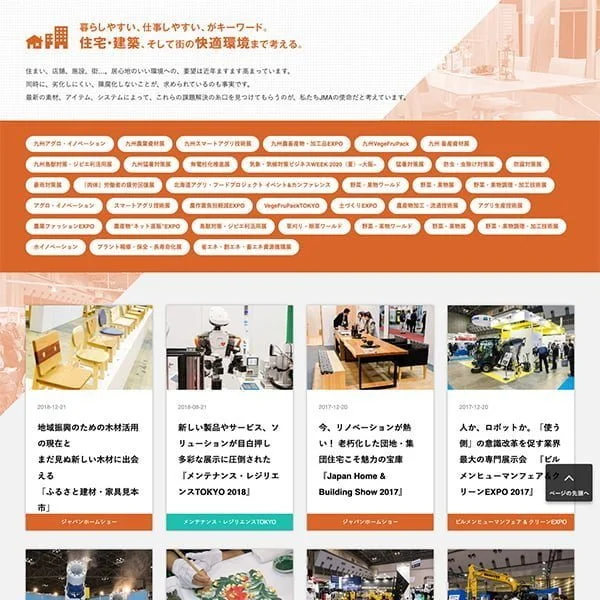
Exhibition Category Summary Pages
Focusing on Informational Keywords for Brand Awareness
It is often said that the more specific a long-tail keyword is, the higher the user’s intent and the more likely they are to convert. However, since the primary objective of this portal site was branding —establishing JMA as a leading exhibition organizer —it was necessary to maintain a broad reach.
Consider how a corporate representative might search when planning to exhibit at or attend an event. They likely start by searching for “[Industry Name] + Exhibition” to list potential candidates. Our analysis using SEO tools confirmed that this keyword combination has high search volume and is highly effective for both brand awareness and driving action.
Category-Specific Summary Pages
To achieve top rankings for these “Industry + Exhibition” middle keywords, we developed dedicated summary pages for each exhibition category. We created pages for 11 categories—including food, tourism, manufacturing, machinery, architecture, and transportation—summarizing the characteristics of each industry and its respective exhibitions. By including links to relevant exhibition reports on these summary pages, we generated interest in individual events and successfully drove traffic to the specific exhibition landing pages.
As a result of these initiatives, we achieved top rankings for various middle keywords. This led to a significant increase in traffic, with the new session rate rising by 13% and overall traffic surging by 342% compared to the previous year. This substantial growth in new users demonstrates that we successfully expanded brand awareness to a completely new audience.
A Specialized Writer Network for High-Quality Content Production
SEO is not merely about technical tricks. Producing high-quality articles is an indispensable element for SEO success. Engaging content ensures that visitors stay on the website longer and consume the information thoroughly. Furthermore, providing valuable information to search engines can lead to higher rankings. Since useful content is frequently shared on social media, investing resources into such material aligns perfectly with what Google values from creators.
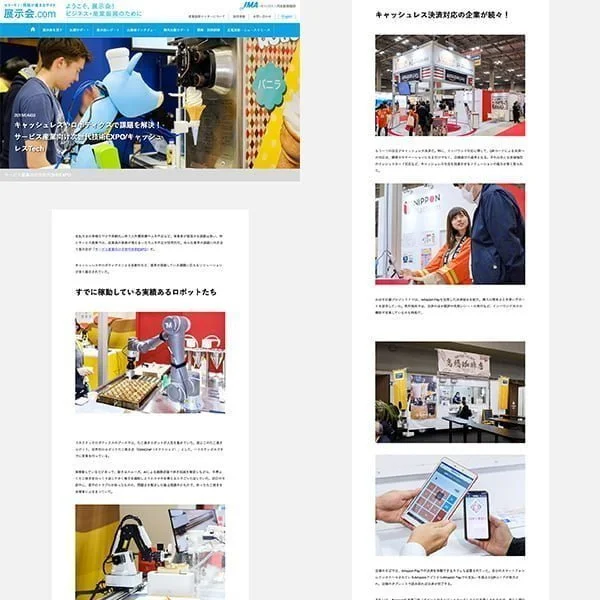
Exhibition Report Articles
Quantity vs. Quality in Writer Selection
While almost anyone can write, and many identify themselves as “writers” on social media, finding the right talent is a different challenge. One can easily find writers through freelance marketplaces like Lancers or CloudWorks based on experience and skill sets, or through job boards like Indeed.
However, creating truly high-quality content requires deep insight and a journalistic approach. In exhibition reporting, specifically, one must have the ability to identify overarching trends among hundreds of exhibitors and communicate them effectively to the reader. Additionally, conducting exhibitor interviews requires the skill to draw out industry-specific insights and convert them into compelling written narratives.
Leveraging PR Connections for SEO Success
In this project, ShapeWin ensured article quality by commissioning freelance writers and journalists from the network we built through years of media relations. Since JMA’s exhibitions are primarily B2B, we assigned writers specializing in IT and manufacturing to handle year-round interviewing and writing. Our SEO specialists then selected target keywords and performed SEO-focused rewrites to optimize for higher rankings.
This commitment to quality yielded significant results. From a digital marketing perspective, we achieved higher search rankings, increased average time on page, improved internal click-through rates, and secured valuable backlinks. From a business perspective, the positive reception from exhibitors led to increased booth sizes, repeat participation, and the acquisition of new exhibitors.
An Obsession with Quality as a Powerful SEO Strategy
Modern SEO prioritizes keyword research to identify traffic-driving terms, high-quality content that resonates with both users and search engines, user experience (UX), mobile-friendliness, and authority-building backlinks.
While SEO discussions often become overly focused on technical tactics, this project demonstrated that prioritizing quality —rather than short-term tactics —is the most effective way to attract both search engines and audiences. Although our commitment to quality resulted in fewer articles being produced within the allocated budget, the number of ranking keywords and overall traffic increased. We believe that sustainable SEO performance can be achieved by aligning closely with Google’s published guidelines and long-term direction. This outcome reflects the strength of ShapeWin’s integrated approach, combining deep-rooted PR expertise with digital strategy.